


Releases
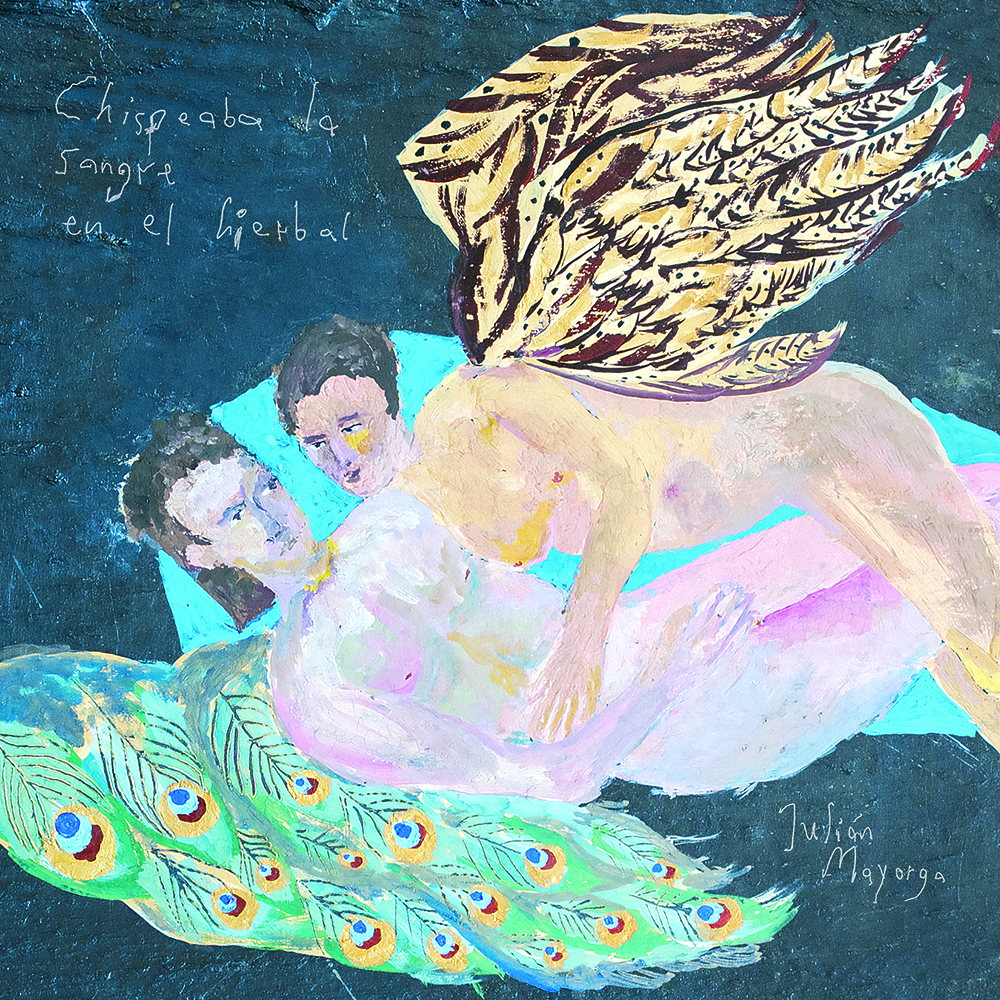
Julián Mayorga • Chispeaba la sangre en el hierbal
Release Date: 15/01/2027
Format: LP/CD/DL
Cat-No: GBCD/LP 192
01. Doyme santa sepultura (02:05)
02. La luz del monte (04:01)
03. Los Santísimos Hermanos (02:43)
04. Gaza (3:24)
05. La matanza en El Aro (3:30)
06. Ardía la policía (4:12)
07. Mi mama (4:22)
08. Mi tayta (3:47)
09. Una mula con mil panzas (3:19)
10. Lame Lame Lame Lame Lame (3:18)
11. Marta, cuando tú te mueras (5:21)
“Draws the off-kilter perspectives of Tom Zé, Tom Waits and Captain Beefheart into his own version of post-cumbia psychedelia.” – The Wire
Celebrated Colombian poet, singer-songwriter and surrealist Julián Mayorga returns with his tenth album, Chispeaba la sangre en el hierbal — an eerie, enthralling collection of dreamlike visions and avant-cumbia experimentation.
Driven by frenetic percussion fashioned from recycled metals, homemade flutes, trombones, jagged guitars, repurposed noises and possessed vocals, the album conjures an unpredictable strain of tropicalism. Tender yet violent, transformative yet elusive, its songs inhabit an otherworldly realm where the surreal and the visceral collide.
A young boy rides on the back of a vulture. Sacred gas cannisters rain down from the sky. Police spontaneously combust. In a street that was once a forest, a boy bathes in petrol. And God lives inside a loaf of bread.
Welcome to the hallucinatory world of Colombian visionary Julián Mayorga’s new album, Chispeaba la sangre en el hierbal (Blood was spattering on the grass).
Since the release of 2014’s Atlas, the Madrid-based artist has established himself as a singular voice, embedding avant-garde poetic evocations within an idiosyncratic sound-world to create a vivid reimagining of South American music and folklore.
“If traditional Colombian or Latin American music is a river, I am not outside that river,” he says. “It’s just that where I swim there is a whirlpool of leaves and branches and old clothes and blood and bones and other filth.”
Mayorga’s music resounds with mutant echoes of Colombian cumbia and other traditional rhythms, investigated with a wry and boundless curiosity that aligns his work with the wild experimentation of Latin American psychedelia.
“In Tropicalismo, even though a song or an album might not always draw on certain formal elements of those more traditional musical styles, it’s understood that the spirit of those styles, of those themes, lives on within it.”
Opening track, ‘Doyme santa sepultura’ (‘I give myself a holy burial’) sets the otherworldly tone that dominates the album, with softly trilling flutes and clopping, junk-yard percussion à la maverick composers Moondog and Harry Partch.
Like Partch, Mayorga is an artisan too, fashioning his own idiosyncratic sound from self-made instruments.
“I have a percussion set that includes dinner plates, knives, saucepan lids, bakery trays, a petrol can, a set of cowbells I bought from a farming shop, metal rods I’ve found in the street, wooden boxes, and so on. A scrap-metal gamelan.”
“I’ve also used flutes that we made with Falsos Discos Falsos, a collective with whom we conceive and create traditional music from imaginary places,” he continues. “They are, for the most part, untempered flutes made from reeds, bamboo, straw and plastic hoses.”
This almost post-apocalyptic skeleton is fleshed out by dreamy loops, gnarled electronics, trombone, synths, electric guitar and more, with Mayorga drawing on the talents of an international coterie of personal friends including Peruvian percussionist Ernesto Velarde, Japanese electronicist Suano Maruyama and Spanish musician Le Parody.
And then there are his own vocals: at one moment – as on ‘La luz del monte (‘The light of the mountain’) – throaty, sonorous and impassioned; the next – as on album closer ‘Marta, cuando tu te mueras (‘Marta, when you die’) – mournful and vulnerable.
Throughout, there’s a sense that Mayorga is channelling the voices of ghosts or imaginary characters in order to tell magical tales and carve weird new myths of the future.
Mayorga’s dense, allusive and deeply poetic lyrics conjure whole worlds of improbable, unsettling and tantalising events and situations.
Releases

Julián Mayorga • Chak Chak Chak Chak
Release Date: 15/11/2024
Format: LP/CD/DL
Cat-No: GBCD/LP 162
01. No te comas las blanquísimas mofetas (02:21)
02. La muerte del perro (04:08)
03. Sueño con culebras (03:09)
04. La venganza de las wawas panches (3:18)
05. El Vorrh (4:00)
06. Tres tristes transeúntes (3:23)
07. El día que el Tolima se hundió hasta el fondo del mar (3:37)
08. ¿El trabajo yo para qué lo quiero? (2:53)
09. Semolina (2:41)
10. Los rolos angloparlantes (3:37)
11. Arda la ciudad cuando arrecie el monte (3:17)
“Listening to Julián Mayorga is hearing the current Colombian sound taken to even more exciting terrain. His music is everything that defines him: experimentation, humor, reflection, passion.” — Vogue (Mexico)
Avant-garde Colombian singer-songwriter Julián Mayorga returns with his ninth album, a clattering, absurdist slice of post-cumbia psychedelia. Chak Chak Chak Chak is a feverish mix of angular electric guitars, circuit-bent beats, found percussion and rapid-fire incantations, with influences that include Tom Zé, Tom Waits and Captain Beefheart.
Frenetic energy meets satirical wit. Surrealist fables entwined with defiant sonics.
——————————–
Part technicolour fever dream, part polyrhythmic Dadaist frolic, Chak Chak Chak Chak is the latest full-length from avant-garde Colombian singer-songwriter Julián Mayorga, an album that brilliantly brings to life his absurdist post-cumbia infused psychedelia.
Broadcasting from the fertile cauldron of his current headquarters in Madrid, where he has lived for the past ten years, Mayorga has created the next compelling phase of his self-proclaimed “timbre rebellion.” Inspired by the sounds of unconventional musical instruments – frying pans, mortar and pestle, knives and plates – his debut release on Glitterbeat (his ninth in all) curdles with an uncanny energy and satirical wit.
Mayorga’s songs are layered, multi-dimensional constructs. They evoke the illusory edge-lands that emerge where urban and rural meet, and echo memories originating in the working-class neighbourhoods of his Tolima birthplace – places abundant with greasepaint and grime, vitality and colour.
As heard on the spry chucho shake-up of the track ‘El día que Tolima se hundió hasta el fondo del mar (The day Tolima sank to the bottom of the sea)’ and the screwball cowboy screed of ‘Arda la ciudad cuando arrecie el monte (Let the city burn when the mountain rages),’ the vistas of Chak Chak Chak Chak are at times earmarked with a decidedly anti-capitalist agrarian model of Andean futurism. “When I return to Colombia, I always spend several days in the countryside,” Mayorga explains, “It always seems to me that people there are living in the future, in an almost anarchic community existing beyond the intermediation of the police or state.”
Uh, all my neighbours descend from the hills,
and in a parade sing,
a clandestine ancient and anti-civilisation song.
— Arda la ciudad cuando arrecie el monte (Let the city burn when the mountain rages)
Finding further inspiration for his sonic fables in the magical writings of Latin American authors such as Juan Rulfo, María Luisa Bombal, Jorge Eduardo Eielson, Reinaldo Arenas and the British poet Brian Catling, Mayorga’s music transmutes the debris of deformity, despair and disgust into chimeric, frenetic song forms, teeming with rat gods, undead dogs, ghost towns and greenback basilisks. With a surrealist’s zeal he refashions the grotesque and gruesome.
I dream of snakes covered in salt
I’m collecting coins adding crumbs
They sprout from the stones I can’t avoid them
Caution is not enough
They stab me in the back at the end of the month.
— Sueño con culebras (I dream of snakes)
Chak Chak Chak Chak vividly highlights Mayorga’s radicalised guitar work, a fecund approach referencing the angular stylings of cult axe heroes such as Kiko Dinucci (Meta Meta), Marc Ribot and, particularly, Arto Lindsay. Riding upon this inventive fretwork, he injects the album with vocal performances marked by rapid-fire incantations, animalistic whoops and hollers and gibbering psychobabble, and a rhythmic scattershot of beats generated by circuit-bent electronics, traditional percussive instruments (tambora and guacharaca) and repurposed objects (giant oil drums and sundry junkyard scrap).
It is indeed not at all surprising that Mayorga counts daring, idiom-defying musical oddballs like Tom Zé, Tom Waits, Renaldo and the Loaf, Captain Beefheart and The Residents (whose classic 1978 cut ‘Semolina’ is reconfigured here in an intoxicating locomotive rush) as kindred influences.
“We have prayed to a giant, ferocious opossum, to come down from the sky to avenge us,” Mayorga writes in the album’s liner notes. “Eat the rich, we implore him, and he answers us with a thick music, a mixture of whistling and clattering, the bones of the richest: Chak-Chak-Chak-Chak.”
The album’s offbeat allegories and anti-capitalist broadsides ooze tropical mischief, dystopian noise and a love for folkloric bestiaries. They are a gloriously bewildering assault on the totems of hegemony and tyranny – cultural, personal, political and musical. An unrelenting sonic cyborg engine – part-machine, part-human – with spluttering gears, gnashing teeth and stuttering cogwheels grinding up against the shrapnel alluded to in the album’s onomatopoeic title.
Chak Chak Chak Chak is Julian Mayorga divining gold amid the ordure. “We need to give birth to beauty, the world needs… people need to be moved. Our manifest destiny is to delve into the beauty of the universe,” he states, before wryly adding, “It just happens that I love the idea of beauty in decay, in ugliness, and even in death.”
Julián Mayorga
“Draws the off-kilter perspectives of Tom Zé, Tom Waits and Captain Beefheart into his own version of post-cumbia psychedelia.” – The Wire
Celebrated Colombian poet, singer-songwriter and surrealist Julián Mayorga returns with his tenth album, Chispeaba la sangre en el hierbal — an eerie, enthralling collection of dreamlike visions and avant-cumbia experimentation.
Driven by frenetic percussion fashioned from recycled metals, homemade flutes, trombones, jagged guitars, repurposed noises and possessed vocals, the album conjures an unpredictable strain of tropicalism. Tender yet violent, transformative yet elusive, its songs inhabit an otherworldly realm where the surreal and the visceral collide.
A young boy rides on the back of a vulture. Sacred gas cannisters rain down from the sky. Police spontaneously combust. In a street that was once a forest, a boy bathes in petrol. And God lives inside a loaf of bread.
Welcome to the hallucinatory world of Colombian visionary Julián Mayorga’s new album, Chispeaba la sangre en el hierbal (Blood was spattering on the grass).
Since the release of 2014’s Atlas, the Madrid-based artist has established himself as a singular voice, embedding avant-garde poetic evocations within an idiosyncratic sound-world to create a vivid reimagining of South American music and folklore.
“If traditional Colombian or Latin American music is a river, I am not outside that river,” he says. “It’s just that where I swim there is a whirlpool of leaves and branches and old clothes and blood and bones and other filth.”
Mayorga’s music resounds with mutant echoes of Colombian cumbia and other traditional rhythms, investigated with a wry and boundless curiosity that aligns his work with the wild experimentation of Latin American psychedelia.
“In Tropicalismo, even though a song or an album might not always draw on certain formal elements of those more traditional musical styles, it’s understood that the spirit of those styles, of those themes, lives on within it.”
Opening track, ‘Doyme santa sepultura’ (‘I give myself a holy burial’) sets the otherworldly tone that dominates the album, with softly trilling flutes and clopping, junk-yard percussion à la maverick composers Moondog and Harry Partch.
Like Partch, Mayorga is an artisan too, fashioning his own idiosyncratic sound from self-made instruments.
“I have a percussion set that includes dinner plates, knives, saucepan lids, bakery trays, a petrol can, a set of cowbells I bought from a farming shop, metal rods I’ve found in the street, wooden boxes, and so on. A scrap-metal gamelan.”
“I’ve also used flutes that we made with Falsos Discos Falsos, a collective with whom we conceive and create traditional music from imaginary places,” he continues. “They are, for the most part, untempered flutes made from reeds, bamboo, straw and plastic hoses.”
This almost post-apocalyptic skeleton is fleshed out by dreamy loops, gnarled electronics, trombone, synths, electric guitar and more, with Mayorga drawing on the talents of an international coterie of personal friends including Peruvian percussionist Ernesto Velarde, Japanese electronicist Suano Maruyama and Spanish musician Le Parody.
And then there are his own vocals: at one moment – as on ‘La luz del monte (‘The light of the mountain’) – throaty, sonorous and impassioned; the next – as on album closer ‘Marta, cuando tu te mueras (‘Marta, when you die’) – mournful and vulnerable.
Throughout, there’s a sense that Mayorga is channelling the voices of ghosts or imaginary characters in order to tell magical tales and carve weird new myths of the future.
Mayorga’s dense, allusive and deeply poetic lyrics conjure whole worlds of improbable, unsettling and tantalising events and situations.