


Releases
Gordan • Gordan
Release Date: 20/11/2026
Format: LP/CD/DL
Cat-No: GBCD/LP 186
01. Dedo Derviš (04:54)
02. Koder (05:26)
03. Mara (05:15)
04. Đuro (07:42)
05. Two Sisters (04:23)
06. Memory of a Birthplace (03:31)
07. Marigold (06:02)
08. Noga Lička A Cipela Bečka (02:15)
09. Oh, My Fields And Meadows (06:32)
Gordan’s powerful 3rd album explores the emotionally charged tradition of Gastarbeiter (“guest worker”) songs. Reimagining these stories of migration and longing, the transnational trio blends Balkan vocal heritage with hypnotic repetition, noise textures, and stark minimalism.
Gordan fuse the artistic vocal tradition of the Balkans with abstraction, energy, and minimalism. With their third album, the band draws upon the nascent tradition of Balkan Gastarbeiter songs, placing them within new musical correlations. Employing the tools of noise and pure sound, Gordan portray personal fates from the perspective of “guest workers.” The stories these songs tell call for openness and empathy. They are invitations to shift one’s perspective.
On this album we encounter a radical recontextualization of traditional Gastarbeiter songs, alongside Gordan’s own artistic reflections on the subject of labor migration. Balkan Gastarbeiter songs are inextricably linked to the history of economic success in Western Europe—but also to the history of resentment and xenophobia. They serve as a reminder of the origins of Western European prosperity and act as a mirror reflecting contemporary attitudes toward migration and dehumanizing isolationist policy.
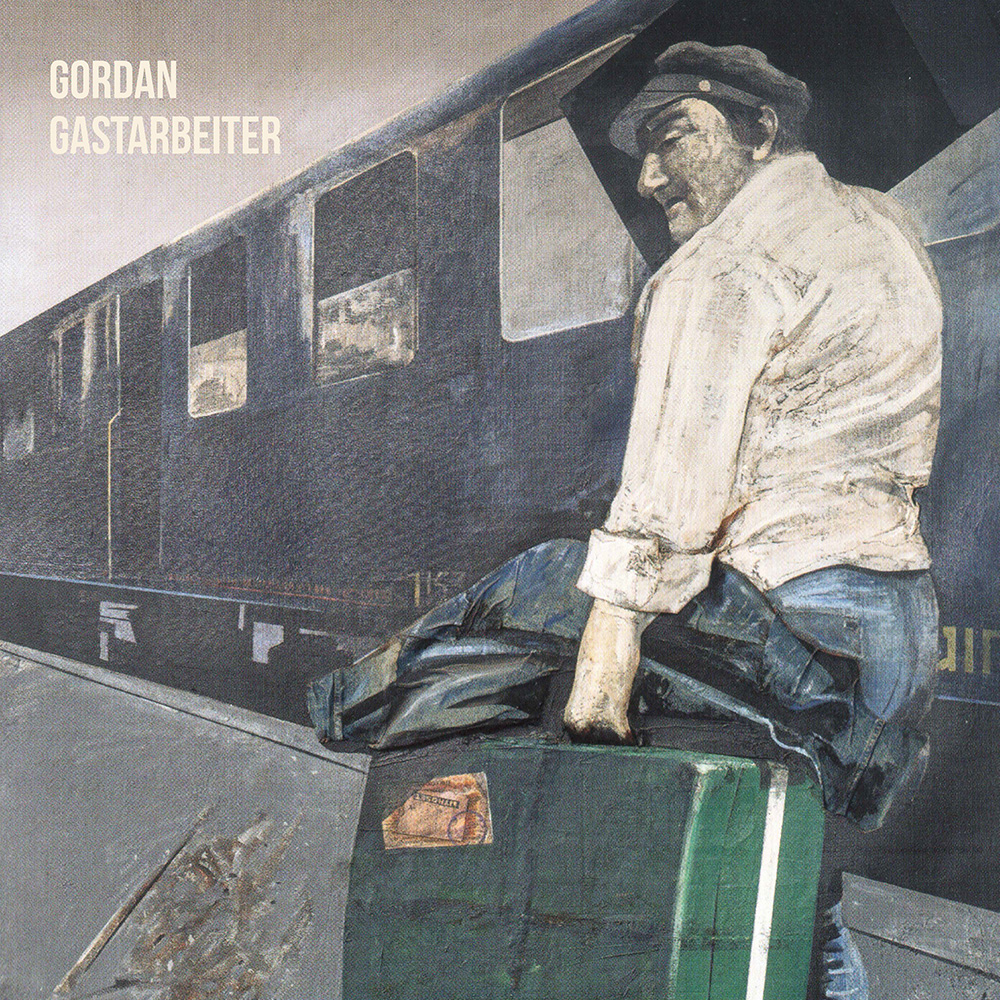
On the front cover of the album is Gvozden, an everyman of socialist Yugoslavia, created by Mića Popović, a famous dissident artist of the former state. As the title of his painting says, Gvozden leaves for temporary residence. The artist ironically plays with the newly built official state’s euphemism, when Yugoslavia, as the only socialist country, made a bilateral workers’ recruitment agreement with West Germany. Of course, nobody would leave a socialist paradise.
The word Gastarbeiter was coined in West Germany in the 1960s and is still used in colloquial speech, particularly in the Balkans, for individuals employed outside their home country. The word has mostly negative connotations and is reduced to generalizations. In Germany, the term has since been replaced with “people with a migration background,” menschen mit migrationshintergrund. Since the 90s, migrant has been considered a more politically correct term.
The singing tradition of guest workers from the Balkans was shaped by people from all the countries of the former Yugoslavia. It is a tradition of ordinary laborers—mostly of rural origin—and their folk music. This does not constitute a distinct folk genre; rather, the guest-worker song tradition represents a thematic sphere encompassing many new motifs: homesickness, the harsh reality of labor, family separation, cultural conflicts, and the act of leaving elderly parents behind in their home villages. The diverse motifs found in the lyrics address themes such as regret over missed opportunities to leave the country and go abroad, or pride in successes achieved in a foreign land—including the respect earned within the local community.
Gordan play with this thematic richness—both lyrically and musically. With its expansive soundscapes, “Dedo Derviš” transforms the satirical poem “Derviš” by Stijepo Đurđević (1579–1632) into a touching ballad. “Noga Lička A Cipela Bečka” is a sort of turbo-folk bastard. “Koder,” by contrast, sounds like a dark prophecy. Then there is the epic “Đuro,” with its interlocking odd-meter patterns and fluttering string textures. And “Oh, My Fields and Meadows”—so poignant in its nakedness.
Drummer Andi Stecher eschews all ornamentation, playing with a style that is simultaneously varied and focused. With inventiveness and superb technique, he serves as the driving force behind the band’s sound. Guido Möbius plays bass guitar and various electronic sound generators; furthermore, he generates feedback using a guitar amplifier, a microphone, and effects. These sounds—at times atmospheric, at others highly concrete—interact with the voice of Svetlana Spajić. Spajić is an internationally renowned expert on the history and practice of a rich and abundant musical tradition. She possesses a mastery and intimate knowledge of the hyper-local vocal styles of the Balkan Peninsula that is virtually unrivaled among contemporary singers.
Releases

Gordan • Gordan
Release Date: 10/05/2024
Format: LP/CD/DL
Cat-No: GBCD/LP 155
01. Barabinska (6:54)
02. Selo moje (5:17)
03. Šara (4:36)
04. The Bell Is Buzzing (5:49)
05. How A Mountain Fairy Divided The Two Jakšić Brothers (5:48)
06. Krajiška kontra (5:14)
07. Ne spominji oči plave (1:29)
08. O Nikola (5:14)
“Gripping, like something ancient being born” — The Wire
“The connection between folk and improvised music, between traditional song and electric noise has been tried in recent years, but rarely as intensively and interestingly.” – Rolling Stone (Germany)
This self-titled 2nd album from this acclaimed transnational (Serbia/Germany/Austria) experimental trio, fuses traditional Balkan vocalizations with feedback, electronic sound generators, pulsing bass and hypnotic drumming.
Gordan mirror the mysticism of legends and stories from the Balkan region, creating a music that stretches between expressiveness and abstraction; tradition and the avant-garde. The visceral vocals of Svetlana Spajic (Marina Abramovic, Robert Wilson, Antony and the Johnsons) are both rooted and deeply interpretive. In turn, drummer Andi Stecher (STECHER, Billy Bultheel, Orchestre Les Mangelepa) and Guido Möbius on bass and electronics, employ sonic strategies that steer the songs in inspired and unpredictable directions.
——————————————-
Gordan make music between expressiveness and abstraction. Their pieces are not limited by rigid formal structures. Instead, they are open processes that create a loss of sense of time. Reduced arrangements and expressive vocals combine to form a powerful musical whole. This band creates something new from minimalism, intensity and the rich singing tradition of the Balkans.
When Down in the Meadow, the first album by Gordan was released by Morphine Records in October 2021, it was celebrated by critics and audience alike. Now the trio presents its second, even more radical album. On this new release, Gordan mirror the mysticism of legends and stories from the Balkan countries with controlled feedback, hypnotic bass, expressive drum playing and the unique vocals by Svetlana Spajic.
Each piece on this album follows another sound idea and historical reference. And with all versatility, Gordan keep a coherent, immediately recognizable sound. There is the opener “Barabinska” with its stoic pulse, celebrating the bohemian lifestyle. It is followed by the noise -oriented, abstract “Selo Moje” with lyrics by Svetlana Spajic. The raw energy of “Šara”, a popular traditional song, contrasts with the lightness of “The Bell is Buzzing”. “Krajiška kontra”, on the other hand, is a dark mantra referring to the times of Militärgrenze in the Balkans.
Drummer Andi Stecher forgoes any ornamentation and at the same time plays varied and concentrated. Confident and with outstanding technique, he is the engine of the band’s sound. His stylistic flexibility demonstrates a profound knowledge of global music history. Guido Möbius plays bass guitar and various electronic sound generators. He also provokes feedback using a guitar amplifier, microphone and effects. These sometimes spherical, sometimes very concrete sounds interact with Svetlana Spajic’s voice. Vocals and feedback circle each other in fleeting, ever-changing harmony.
Spajic is an internationally recognized expert on the history and practice of a rich musical tradition. She knows and masters the hyperlocal singing styles of the Balkan Peninsula like no other contemporary singer. At the same time, she works as an active part of this culture to open it up and re-contextualize it. Spajic has worked with many international art and music universities as well as international stars of contemporary and avant-garde music.
Biographies:
Svetlana Spajić is renowned for her performing, researching and teaching work in Balkan traditional singing. Her research led her to roam the Balkans for the last 25 years, studying with the village singers of the oldest living generation. She has published or produced some twenty albums, mostly the projects of preserving intangible traditional culture. She has embodied her knowledge and experience into working process of many groups in the field of traditional singing art in the country and abroad, among them her Belgrade- based female ensemble Svetlana Spajic Group. She has collaborated with many greats of both traditional music and of the contemporary avant-garde – including: Hronis Aidonidis, Domna Samiou, Yanka Rupkina, Cherifa Kersit, Stella Chiweshe, Marina Abramovic, Robert Wilson, Zeitkratzer, Antony and the Johnsons, Sainkho Namtchylak, William Basinski, Urs Leimgruber and many others.
www.svetlanaspajic.com
Andi Stecher is an Austrian born drummer, producer and composer. Stecher’s music is not drawn to one specific genre. He refers to a variety of styles of music in his pieces and therefore forms a very unique hybrid sound. In addition to his work as a composer and his beat / Avant-pop / drill production outlet STECHER, he plays in a diverse range of bands and projects and composes for a wide variety of media. Collaborations including: Billy Bultheel (Pan), Matana Roberts (Constellation Records), Love Lokembe (Moonshine), Orchestre Les Mangelepa (Strut Records), Don the Tiger (Crammed Discs), Carla Bozulich (Constellation records), Doudou N’Diaye Rose.
http://andistecher.org/
Guido Möbius has released six albums and countless 7-inches, split LPs and compilation contributions on labels such as dekorder, Karaoke Kalk, clapping music or Shitkatapult. As a solo artist he played numerous club tours and international festivals. In his highly energetic live sets Möbius creates delicate links between experimentation, handmade techno, noise, polyrhythmic patterns, acid and gospel music. Guido Möbius runs Autopilot Music Publishing, a publishing house that represents artists like Nicholas Bussmann, Black To Comm, Reinhold Friedl and many more.
www.guidomoebius.com
About the Songs:
Most of the songs on the album consist of free-chained rhymed couplets (barabinske, bećarci, ojkače), from the Western Balkan regions. Unlike the old epic songs from which they borrowed the famous deseterac (ten–syllable trochaic verse with seizure after the fourth syllable), these present-day poetic “cycles“ express profane ideas, or ideals, such as bohemian, vagabond style of life (Barabinska), or obsession with outcast tough ways, guns and clashes with officers of the law, as a reflex of constant warships in Militärgrenze – in Serbian: Vojna krajina (track Krajiška kontra). The “cycle” of Nikola Tesla (O Nikola) was made by Milan Bilbija, a deceased unknown singer whom Svetlana met in the late 90ies in Čirkin Polje in Northwest Bosnia – the song brings almost the entire inventory of the scientist’s patents along with the weird facts and melancholy of Tesla’s life. These songs we made move without any progression or development as if suddenly someone tuned the radio to the channel of an ever-existing, never-ending beating of the song in the space.
Opposite to the above-mentioned rhymes which can still be heard here and there across Western Bosnia, or Dalmatia, the track of the long title, How A Mountain Fairy Divided The Two Jakšić Brothers, belongs to bugarštica, a form which can nowadays only be found in the anthologies of oral poetry. Despite its long, complex verse, it was the ultimate pop song of the Southern Slavs somewhere between the 15th and the 18th century and spread by the traveling bards all along the Adriatic coast. As far as we know, for the first time in popular culture Gordan is bringing this gracious and bulky form back to life. Here, the sound scenery we build gradually, for the trochee pulsation of a newly found melodic mode of the verse, as well as for the turmoil of a brother-killing jealousy episode.
Selo Moje was entirely made by Svetlana during one of her stays in the village of Žegar, in Dalmatia, with her friends and singing mentors who are now in their late 80ies. The track is a sound debris made by Guido and Andi of a singer’s remembrance of the place and its protagonists.
And there are two strong references to some of the icons of folk singing from the 70ies and 80ies in the ex-Yu: Šara, an old traditional song with the motif of the three shepherds struck by the avalanche in Šara Mountain, is a tribute to Bora Spužić Kvaka, an offbeat of the popular folk scene in socialist Yugoslavia who made it widely popular and part of the canonic Balkan kafana repertoire in the 70ies. Ne spominji oči plave is a new homage to the deepest of all undergrounds of the ex-Yugoslavia, the cultural dark web which sold out millions of records and paid the biggest tax on Schund in the former state, Južni vetar. Along with its singer Šemsa Suljaković from the previous Down in the Meadow album, here the miniature is dedicated to Svetlana’s neighbor from Loznica birthplace, the dynamis of the voice of the archangel at the end of time, Sinan Sakić.
Finally, the first single from the album, The Bell is Buzzing, is a widespread love song in the Balkans with the motif of a girl who is enchanted by the shepherd, but in some songs, she betrays him and finds another lover. In our song, she proposes to him a wedding.
Gordan
Gordan’s powerful 3rd album explores the emotionally charged tradition of Gastarbeiter (“guest worker”) songs. Reimagining these stories of migration and longing, the transnational trio blends Balkan vocal heritage with hypnotic repetition, noise textures, and stark minimalism.
Gordan fuse the artistic vocal tradition of the Balkans with abstraction, energy, and minimalism. With their third album, the band draws upon the nascent tradition of Balkan Gastarbeiter songs, placing them within new musical correlations. Employing the tools of noise and pure sound, Gordan portray personal fates from the perspective of “guest workers.” The stories these songs tell call for openness and empathy. They are invitations to shift one’s perspective.
On this album we encounter a radical recontextualization of traditional Gastarbeiter songs, alongside Gordan’s own artistic reflections on the subject of labor migration. Balkan Gastarbeiter songs are inextricably linked to the history of economic success in Western Europe—but also to the history of resentment and xenophobia. They serve as a reminder of the origins of Western European prosperity and act as a mirror reflecting contemporary attitudes toward migration and dehumanizing isolationist policy.
On the front cover of the album is Gvozden, an everyman of socialist Yugoslavia, created by Mića Popović, a famous dissident artist of the former state. As the title of his painting says, Gvozden leaves for temporary residence. The artist ironically plays with the newly built official state’s euphemism, when Yugoslavia, as the only socialist country, made a bilateral workers’ recruitment agreement with West Germany. Of course, nobody would leave a socialist paradise.
The word Gastarbeiter was coined in West Germany in the 1960s and is still used in colloquial speech, particularly in the Balkans, for individuals employed outside their home country. The word has mostly negative connotations and is reduced to generalizations. In Germany, the term has since been replaced with “people with a migration background,” menschen mit migrationshintergrund. Since the 90s, migrant has been considered a more politically correct term.
The singing tradition of guest workers from the Balkans was shaped by people from all the countries of the former Yugoslavia. It is a tradition of ordinary laborers—mostly of rural origin—and their folk music. This does not constitute a distinct folk genre; rather, the guest-worker song tradition represents a thematic sphere encompassing many new motifs: homesickness, the harsh reality of labor, family separation, cultural conflicts, and the act of leaving elderly parents behind in their home villages. The diverse motifs found in the lyrics address themes such as regret over missed opportunities to leave the country and go abroad, or pride in successes achieved in a foreign land—including the respect earned within the local community.
Gordan play with this thematic richness—both lyrically and musically. With its expansive soundscapes, “Dedo Derviš” transforms the satirical poem “Derviš” by Stijepo Đurđević (1579–1632) into a touching ballad. “Noga Lička A Cipela Bečka” is a sort of turbo-folk bastard. “Koder,” by contrast, sounds like a dark prophecy. Then there is the epic “Đuro,” with its interlocking odd-meter patterns and fluttering string textures. And “Oh, My Fields and Meadows”—so poignant in its nakedness.
Drummer Andi Stecher eschews all ornamentation, playing with a style that is simultaneously varied and focused. With inventiveness and superb technique, he serves as the driving force behind the band’s sound. Guido Möbius plays bass guitar and various electronic sound generators; furthermore, he generates feedback using a guitar amplifier, a microphone, and effects. These sounds—at times atmospheric, at others highly concrete—interact with the voice of Svetlana Spajić. Spajić is an internationally renowned expert on the history and practice of a rich and abundant musical tradition. She possesses a mastery and intimate knowledge of the hyper-local vocal styles of the Balkan Peninsula that is virtually unrivaled among contemporary singers.